Your compass is a little off.
Working it out from IGRF-14, the reference model of Earth's magnetic field.
Or pick one:
All readings and charts.
Your place, in plain words
How the field enters the ground
Your compass, 1900 to 2030
The sun's path today
Months when the noon sun climbs past 45° at this latitude.
Today's light by sun height, local time.
Bands by sun height alone. Cloud, ozone, height and reflection also change the light on the ground.
UV index by hour today, local time. Amber hours are 3 or more.
Your magnetic neighbourhood.
The same declination map, drawn close around your spot. Green is the agonic line. Each thin line is one more step of compass offset: blue where the compass is pulled west, red where it is pulled east. Where the lines crowd together, the field changes fast over a short distance. Triangles are young volcanoes.
Sunlight, piece by piece.
Sunlight is a set of parts that arrive together. This is the spectrum that reaches the ground, with the wavelengths that matter most to the body marked on it: where vitamin D is made, where the eye's clock listens, and where the mitochondrion absorbs red light.
Where you are in the light year
The length of the day at your spot across the year, with today marked. The amber band along the bottom shows the part of the year when strong UVB reaches the ground at noon. Read this way, it is the calendar the body eats and sleeps by.
Latitude sets the dose
Days a year when the noon sun climbs past 45° and strong UVB reaches the ground, against distance from the equator. The amber dot is your spot.
In harvest near you.
What farmers are harvesting, month by month, in the country of your spot. This comes from published harvest calendars: the UN Food and Agriculture Organization's crop calendar, seasonal produce lists from the US Department of Agriculture and the European Commission, and a global calendar of staple crops that covers every country with cropland.
Loading the harvest calendars.
The engine: a wiring diagram.
Everything on this page ends in one place: the inner membrane of the mitochondrion, where electrons from food are walked down a chain of proteins to oxygen. This is a picture of that chain, and of where each part of sunlight and the local magnetic field is thought to act on it.
From the planet to the cell
One idea runs through every scale, from the iron core of the Earth down to a gap a few atoms wide. Five steps, with the numbers for your spot.
Inside the membrane
The brake. In this model ultraviolet slows the flow. UVB works through the vitamin D receptor on the inner membrane, between complexes III and IV. UVA makes nitric oxide, which slows complex IV.
The motor. Red and near-infrared light are absorbed at four sites in complex IV and keep ATP synthase turning, even when fewer electrons arrive. That is why, in this model, red light belongs together with UV.
The pile-up. When the spacing between the proteins goes wrong, electrons back up at complexes I to III. This is called a Marcus inversion, and the model ties the spacing to the local magnetic field, which holds the folds of the membrane in line.
The spin chemistry under your feet.
How does a field as weak as Earth's reach into chemistry? Through electron spins. The best-understood route is the radical pair: two electrons born together as a singlet, turned by the field and by a nearby nucleus, recombining one way or the other. It is the leading explanation for how migratory birds sense north. Below, that model runs live in your browser for your spot's real field.
The model: two electron spins and one nucleus, an axial hyperfine coupling of 1 mT, recombination at one per microsecond, solved exactly (8 quantum states). A simplified version of the same spin system, sampled at one fixed moment rather than over the pair's lifetime, ran on IBM's ibm_fez processor on the 9th of November 2026: the singlet probability came out 0.91 with the molecule along the field and 0.07 across it, so the angle effect survives on real quantum hardware. The model is deliberately minimal: real radical pairs couple to many nuclei.
The agonic line keeps walking.
The green line is the agonic line, where magnetic and true north agree. Blue lines join places where a compass is pulled west, red lines where it is pulled east, one line for every 5°. This is the standard declination map. Drag through the years. Click anywhere on the map to make it your spot.
Space weather, right now.
Live from NOAA's Space Weather Prediction Center, NASA and the USGS, unsmoothed.
| Loading NOAA feeds |
Kp, the last seven days
The next 27 days, as NOAA forecasts them
The Sun turns about once every 27 days, so active regions come back around. NOAA's daily planetary Kp outlook; days at Kp 5 or more are storm days.
Earthquakes, magnitude 4.5 and up, last day
- Loading the USGS feed
Aurora, NOAA's short forecast
Loading NOAA's aurora model.
Schumann resonance
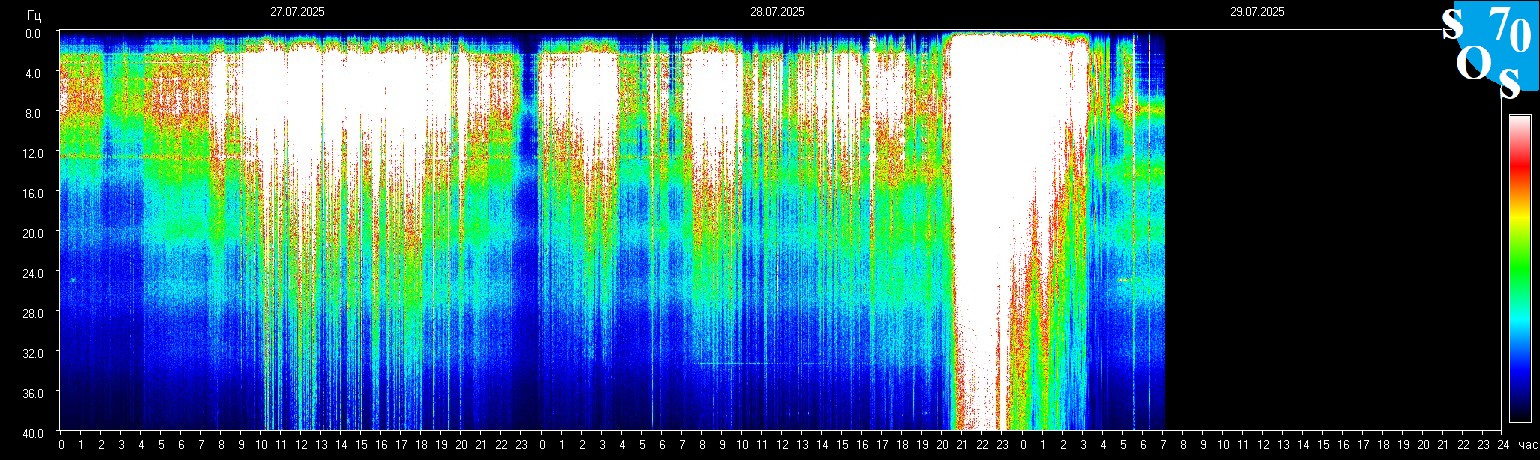
The Earth and the ionosphere ring like a bell, lightning keeps it ringing, and the base tone sits near 7.83 Hz with overtones near 14.3, 20.8 and 27.3 Hz. This is the live spectrogram from Tomsk State University's observatory in Siberia, shown in one tone. Brighter bands mean a louder ring.
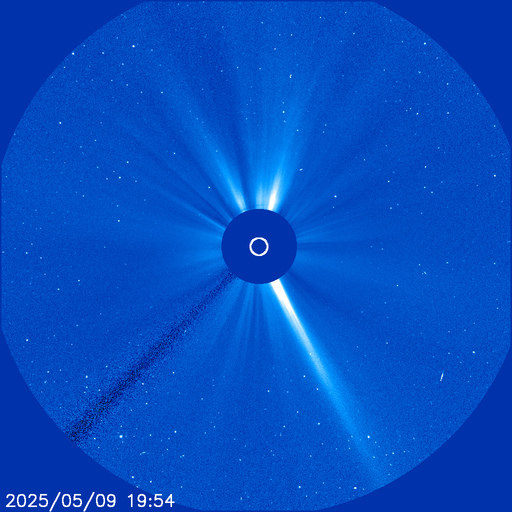
The Sun, right now
NOAA alerts, latest first
- Loading NOAA alerts
Ideas from quantum biology, in numbers.
Each idea is given in plain words, and beside it the numbers that can be measured or computed for it today, including for your own spot.
An experiment: which way to sleep.
Lying down, the vertical part of the field always crosses the body, whichever way the bed points. Only the horizontal part changes: along the body when you lie north to south, across it when you lie east to west. In the radical-pair model, that turn moves the outcome by about 30% in mid-latitudes.
The experiment is simple enough for anyone to run:
- Baseline nights with the head to the west.
- Nights lying north to south.
- Repeat both once.
- Each morning: heart-rate variability by phone camera and a score from 1 to 10.
Results pending
The first results will be posted here as they come in.
Today, in one line.
Waiting for the live feeds.
Time, the Zeno effect and Bitcoin.
Bitcoin and time
Watch a quantum system often enough and it holds still. One view sees life using this effect to hold on to time, and Bitcoin doing the same for money.
The quantum Zeno effect is easy to state and strange to see. A qubit was turned from 0 to 1 in eight small steps and measured after each one. It stayed at 0 in 73.5% of runs, against 73.3% in theory. Left unwatched, it arrived at 1 every time. Watching held it where it was.
Bitcoin watches itself in the same spirit. Every 2,016 blocks, about two weeks, the network measures its own pace and resets the difficulty, so a new block keeps arriving about every ten minutes however much computing power joins. The supply cannot be hurried. That is why time and bitcoin are counted here as the two things that are truly scarce.
Run on IBM ibm_fez, 9 November 2026
Support Earthdrifts in Bitcoin
No ads, no tracking, no paywall. If this page is useful to you, Bitcoin is welcome. Nothing is expected.
Glossary.
The terms that come up when people talk about light, magnetism and the body, in plain language.
Agonic line
Where a compass points exactly to true north. It is not fixed: it sweeps across continents over decades as the field changes.
Declination
The angle between magnetic north and true north at a place. Zero on the agonic line.
Inclination, or dip
The angle at which the field enters the ground. Flat at the magnetic equator, straight down at the north magnetic pole and straight up at the south one.
Horizontal field
The part of the field that runs along the ground. A flat field has a large horizontal part; a steep one has a small one.
Nanotesla (nT)
The unit for magnetic field strength used here. Earth's surface field runs from about 22,000 to 67,000 nT.
Secular variation
The slow, year-to-year change in Earth's field, driven by flow in the liquid iron core.
South Atlantic Anomaly
A large region over South America and the South Atlantic where the field is weakest, and growing.
Magnetic poles
Where the field points straight down or up. The north one has moved about 2,475 km since 1900, from Canada toward Siberia.
Kp index
A 0 to 9 scale of how disturbed the field is, every three hours. 5 and above is a storm.
Solar wind and Bz
The stream of particles and magnetic field from the Sun. A southward Bz lets its energy into Earth's field.
Schumann resonance
Very low radio frequencies that ring between the ground and the ionosphere, kept going by lightning. The base tone is near 7.83 Hz.
UV index, UVA and UVB
Sunlight's ultraviolet comes as longer UVA and shorter UVB. UVB is filtered hard by the atmosphere and reaches the ground mainly when the sun is high.
Solar noon
When the sun crosses the local meridian, usually due south or north, and stands near its highest for the day.
Radical pair
Two molecules each holding one unpaired electron, born together. Their spins can be turned by a weak field, which changes how they react. It is the leading explanation for the bird compass.
Singlet yield
In a radical pair, the share that reacts in the paired (singlet) state. A change in it is how a magnetic field changes chemistry.
Zip code
In quantum biology talk, shorthand for everything a place and time give a body: its light, its magnetic field, its season and its environment. This page is a zip code report.
Solar callus
The idea that skin and eyes build tolerance to strong sun gradually, with morning red and infrared light before the stronger UV of midday.
Deuterium
Heavy hydrogen: a hydrogen atom with an extra neutron. Ocean water holds about 156 parts per million; rain toward the poles and at altitude holds less. Deuterium-depleted water (DDW) is water with less than that.
IR-A, near-infrared
The light just beyond red, from about 700 to 1,400 nm. It cannot be seen, and it is in sunlight from sunrise to sunset.
Neuropsin
A light sensor in the skin and the cornea that responds to UVA, around 380 nm.
Melanopsin
A light-sensing protein in the eye, most sensitive to blue light around 480 nm, that tells the body's clock whether it is day.
nnEMF
Non-native electromagnetic fields: man-made radio, microwave and power-line fields, as opposed to the fields of sunlight and the Earth itself.
Isogonic lines
Lines joining places with the same compass offset. On the standard declination map they are blue where the compass is pulled west and red where it is pulled east; the green agonic line, at zero, runs between them.
Magnetic excursion
A period when Earth's field weakens strongly and wanders without fully reversing. The best known is the Laschamp excursion, about 41,000 years ago.
The framework
The view this page is organised around: a place acts on the body through three things, its light, its water and its magnetic field. Each reading here belongs to one of the three. The framework is the work of Dr. Jack Kruse.
Lattice lock
A term for the water and collagen of the body turning thick and stiff when deuterium builds up in a weak field, so that ATP synthase can no longer turn freely.
Defrag
A word for the body clearing built-up deuterium, mainly through the vagus nerve and the gut.
Magnetic pinning
A term for a place's field holding the body's structures in line. The strongest pinning is tied to young volcanic rock and a strongly horizontal field.
Astronauts on Earth
A phrase for people living where the field is weak or disturbed. In this view they show the same changes astronauts show after leaving Earth's field.
Triplet oxygen
The ordinary, magnetic state of the oxygen we breathe: its two outer electrons spin the same way. In this framework a healthy field keeps oxygen in this state, which collagen and melanin need.
Dielectric constant
A measure of how well a material holds an electric field. Ordinary water measures about 78. Structured water inside a working mitochondrion is put at about 160.
Marcus inversion
A name for electrons backing up in the mitochondria when the spacing of the respiratory proteins goes wrong, borrowed from Rudolph Marcus's theory of electron transfer.
IGRF
The International Geomagnetic Reference Field, the standard model of Earth's field, renewed every five years by the world's geomagnetism community.
How these numbers are made.
- The field at your spot
- Computed in your browser from IGRF-14, the International Geomagnetic Reference Field adopted by IAGA in December 2024, valid from 1900 to 2030. Years after 2025 use the model's predicted rate of change. The model describes the field from Earth's core; local rocks and buildings can shift a compass by a further degree or more in some places, so treat the declination as the regional value at sea level.
- Distance to the agonic line, isogonic lines and volcanoes
- The distance is the shortest great-circle distance from your spot to today's agonic line, found on a 2° grid and refined to a quarter of a degree; treat it as good to about 20 km. Isogonic lines are drawn every 5° of declination. Line spacing comes from how fast declination changes across one degree around your spot. Volcanoes are the roughly 1,500 with eruptions in the last 12,000 years in NOAA NCEI's volcano location list, which follows the Smithsonian's Global Volcanism Program.
- The agonic line, the weak-field region and the pole
- The agonic line is traced on a 2.5° grid wherever the east component of the field is zero and the compass points north. The shaded region marks where total field strength at the surface is under 28,000 and under 24,000 nT. Pole positions are NOAA NCEI's yearly modelled north dip pole.
- Sunlight
- Sun height is calculated from the date, time and your coordinates with a standard low-precision solar formula, good to a fraction of a degree, without atmospheric refraction. Sunrise, sunset, day length and UV index come from Open-Meteo's forecast for the spot.
- Space weather
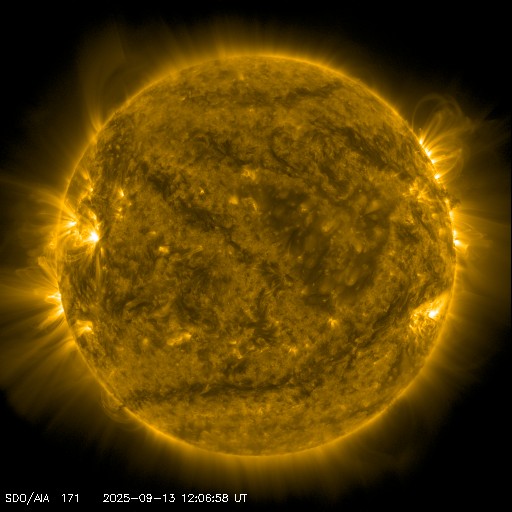
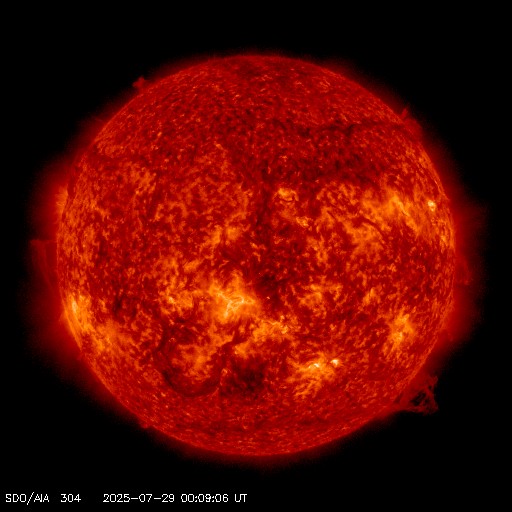
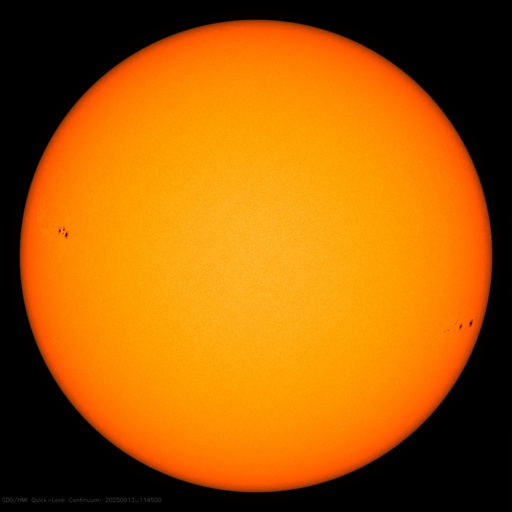
- Kp, solar wind, the Sun's magnetic field at L1, X-rays, alerts and the 27-day outlook come straight from NOAA's Space Weather Prediction Center; the aurora maps are drawn here from NOAA's OVATION model; Sun images from NASA SDO and SOHO, shown in one tone; the Schumann spectrogram from Tomsk State University; earthquakes from the USGS. Each value shows how old it is where the source gives a time.
- Harvest calendars
- The harvest lists are published calendars, not estimates made here. Every country is covered at one of three levels. For 57 countries the FAO Crop Calendar gives sowing and harvest dates for each crop in each farming zone; a crop is shown for a month when that month falls inside its harvest window. For the United States and 27 European countries, fruit and vegetables come from seasonal lists of the US Department of Agriculture and the European Commission, which work by season; the Commission's lists are by climate zone and for a few countries cover only part of the country, which the page states. For every country with cropland, staple crops (grains, roots, pulses and oilseeds) come from MIRCA2000, a global set of crop calendars describing farming around the year 2000 (Portmann, Siebert and Döll, 2010); a crop is listed in the month its growing season ends, and minor crops under a quarter of a percent of the area are left out. The country is taken from the place you searched, or from the country outline your spot falls in. Where a country has no fruit and vegetable calendar yet, or no field crops on record, the page says so.
- Night mode
- After sunset where you are, this page switches to red on black and sends no blue or green light: every colour, photo and map is reduced to its red part. It switches back at sunrise. The button at the top sets it to auto, day or night. Sunset is worked out from the city of your device's time zone, not from the place you are looking up. A screen's own backlight can still leak a little blue, and the page cannot change how a screen dims itself.
- The ideas
- Each idea is given in plain words. The ideas were drawn from public talks on Redpills TV, Decentralized Mind, the Medisun Podcast, Sowing Prosperity, Holistic Disclosure, Justin Health, Luke Lambie, Nourish Vermont, Regenerative Health, TFTC and Tone Vays. The numbers beside them are computed from IGRF-14, run on IBM quantum hardware or taken from the published source named, and dated. If you find an error, it gets corrected here with the date.